Octal Number System
Comparison to Binary numbers, because if we present any number in binary, it will be long, while in the case of an octal number, that array of numbers will be shorter.
- The numbers are formed using 8 digits, i.e., 0, 1, 2, 3, 4, 5, 6, 7.
- It is useful for representing file permissions in Unix/Linux operating systems.
- Each digit in the number is at a specific place value that is powers of 8.
- From right to left – as powers of 8, i.e., 80, 81, 82, etc.
(741) is written as
782 + 481 + 180
764 + 48 + 11
481
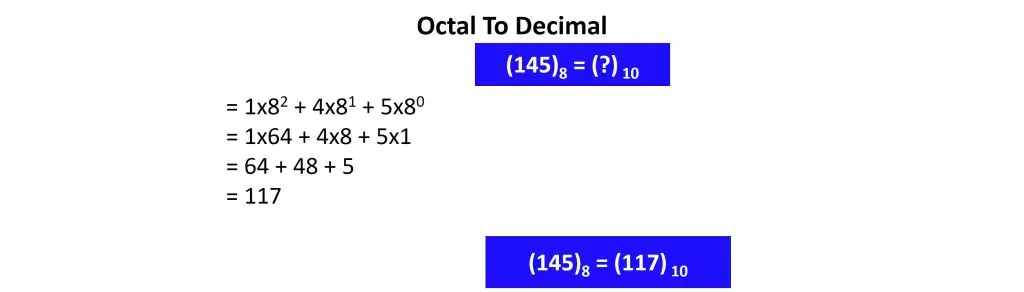
Octal to Decimal Conversion
Octal number uses base 8, whereas decimal has base 10. To convert from octal, use the following steps.
Step 1: Identify the Positional Weights
Each digit in an octal number has a weight based on its position, starting from the right (before the decimal point) at 80.
- The 1st digit from the right is 80 = 1
- The 2nd digit from the right is 81 = 8
- The 3rd digit from the right is 82 = 64
- The 4th digit from the right is 83 = 512
Step 2: Multiply Each Digit
Multiply each digit of the octal number by its corresponding power of 8, increasing from LSB to MSB
Step 3: Sum the Results
Add all the products together to get the final decimal value.
Octal to Binary Conversion
To Convert octal number into Binary, use the following octal binary table. Write the corresponding value of each octal into binary directly.
| Octal | Binary |
| 0 | 000 |
| 1 | 001 |
| 2 | 010 |
| 3 | 011 |
| 4 | 100 |
| 5 | 101 |
| 6 | 110 |
| 7 | 111 |
By using the binary value of each octal digit, you can convert Octal to Binary directly

Octal to Hexadecimal Conversion
The octal number system cannot be converted directly to hexadecimal. To convert, we have to go through either the Decimal or the Binary system. That means first we have to convert octal into decimal or binary, then that decimal or binary needs to be converted into hexadecimal.
Octal to Hexadecimal conversion using Decimal
Follow these steps to convert octal into decimal
Step 1: Identify the Positional Weights
Each digit in an octal number has a weight based on its position, starting from the right (before the decimal point) at 80.
- The 1st digit from the right is 80 = 1
- The 2nd digit from the right is 81 = 8
- The 3rd digit from the right is 82 = 64
- The 4th digit from the right is 83 = 512
Step 2: Multiply Each Digit
Multiply each digit of the octal number by its corresponding power of 8, increasing from LSB to MSB
Step 3: Sum the Results
Add all the products together to get the final decimal value.
Now Convert Decimal into Hexadecimal
To convert a decimal to Hexa decimal, here are some steps.
- Divide the decimal number by 16.
- Record the remainder (from 0 to 15, where 0-9 is denoted by a number and from 10 to 15 represented by A-F, respectively).
- Divide the quotient again by 16 and repeat until the quotient becomes 0.
- Read the remainders backward (from last division to first) to get the octal number.
After these steps Octal number is first converted into Decimal, then Hexadecimal. In this way, we can convert octal into Decimal.
Octal to Hexadecimal conversion using Binary
To use this method, first convert octal into binary, then that binary into Hexadecimal
Octal to Binary
To convert an octal number into Binary, use the following octal binary table. Write the corresponding value of each octal into binary directly.
| Octal | Binary |
| 0 | 000 |
| 1 | 001 |
| 2 | 010 |
| 3 | 011 |
| 4 | 100 |
| 5 | 101 |
| 6 | 110 |
| 7 | 111 |
Binary to Hexadecimal Conversion
To convert from binary (Base 2) to hexadecimal (Base 16), follow these steps:
- Group into Fours: Starting from the right (the least significant bit), divide the binary number into groups of four bits.
- Pad with Zeros: If the leftmost group has fewer than four bits, add leading zeros to complete the group.
- Assign Hex Values: Convert each 4-bit group into its equivalent hexadecimal digit (0-9, A-F).
Use the positional weights (23=8, 22=4, 21=2, 20=1) to convert each 4-bit group into its equivalent hexadecimal value (0 through 9 & A-F).
| Hexadecimal | Binary |
| 0 | 0000 |
| 1 | 0001 |
| 2 | 0010 |
| 3 | 0011 |
| 4 | 0100 |
| 5 | 0101 |
| 6 | 0110 |
| 7 | 0111 |
| 8 | 1000 |
| 9 | 1001 |
| 10-A | 1010 |
| 11-B | 1011 |
| 12-C | 1100 |
| 13-D | 1101 |
| 14-E | 1110 |
| 15-F | 1111 |

Published March 2026. Last verified: March 2026.