Artificial Intelligence is no longer the future it is the present, and it is moving faster than most students realize. If you are studying computer science in Nepal or anywhere in South Asia right now, the AI revolution directly affects your career, your studies, and even how you learn.
This article breaks down the biggest AI developments of 2026 in plain language, explains what they actually mean for students, and gives you practical steps to stay ahead.
1. AI Has Reached 53% of the World’s Population in Just Three Years
Here is a number that puts everything in perspective: generative AI tools like ChatGPT, Gemini, and Copilot have been adopted by more than half the world’s population in just three years. According to Stanford University’s 2026 AI Index Report, generative AI reached 53% population adoption faster than the personal computer or the internet ever did.
For comparison:
- The internet took about 7 years to reach 50% adoption in developed countries
- The smartphone took 5–6 years
- Generative AI: just 3 years
This is not just a trivia fact. It tells you that whatever field you enter after graduation, whether IT, business, healthcare, or education, AI will already be deeply embedded in how that field operates. Being unfamiliar with AI tools in 2026 is like not knowing how to use a computer in 2005.
What this means for you: Start using AI tools in your studies now, not to cheat, but to learn faster. Use them to explain concepts you don’t understand, to check your code, to summarize long documents.
2. Google’s Gemini Is Now a Personal Coding Tutor
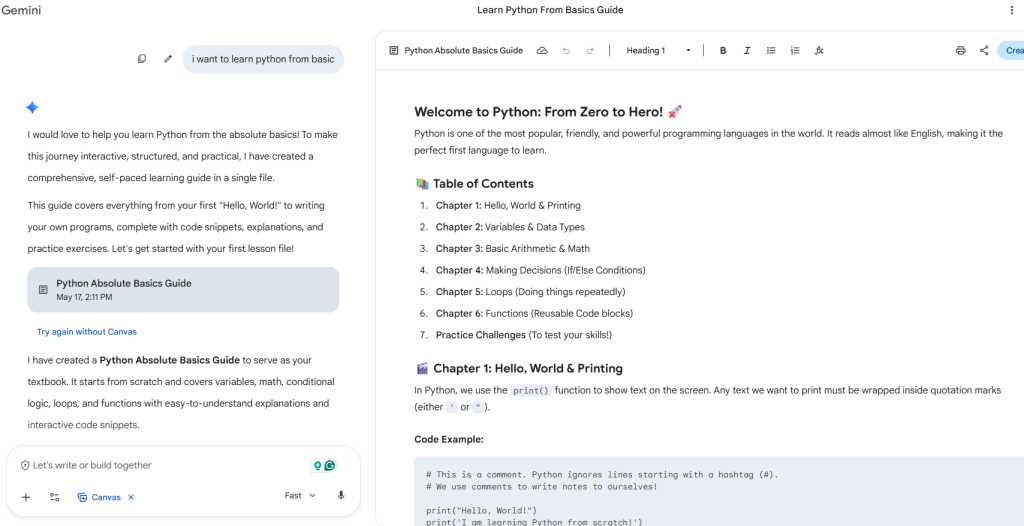
At Google Cloud Next ’26, held in April 2026, Google made over 260 announcements. One of the most exciting features for students: Gemini is now available inside Google Colab as a personal coding tutor.
Google called this feature “Learn Mode in Colab,” and it transforms the popular online coding environment into an interactive learning experience. Instead of just running your code, Gemini can now:
- Explain why your code is wrong step by step
- Suggest improvements and teach you the concept behind them
- Act like a patient tutor available 24 hours a day, 7 days a week
Additionally, Google launched a free AI Agents Vibe Coding Course in partnership with Kaggle, the world’s largest data science community, which teaches people how to build software using AI agents even without deep programming knowledge. The course opened for registration in May 2026.
Google also made Google Vids completely free, allowing anyone with a Google account to generate up to 10 professional-quality AI-generated videos per month.
What this means for you: If you are struggling with programming concepts, open Google Colab, enable Gemini, and ask it to teach you. It is free, patient, and available right now.
3. Software Developer Jobs Are Actually Growing, Not Shrinking
One of the biggest fears students have about AI is this: “Will AI take my programming job before I even graduate?“
The data from 2026 tells a more nuanced story. According to Microsoft’s Global AI Diffusion Report, published in May 2026, AI-assisted coding tools led to a 78% year-over-year increase in code pushed to GitHub globally. More software is being written than ever before.
And crucially: U.S. software developer employment reached a record high of 2.2 million in 2025, growing 8.5% year over year. Early 2026 data shows developer employment is still rising at about 4% compared to the previous year.
Why? Because AI lowered the cost and time to build software, it made it viable to build more software for more use cases. Think of it like calculators and accountants; calculators did not eliminate accounting jobs, they made accountants more productive and created demand for more complex financial work.
However, the nature of the job is changing. The developers being hired are those who can:
- Use AI tools (GitHub Copilot, Claude Code, and Cursor) effectively
- Understand AI-generated code and spot its mistakes
- Design systems and solve problems, not just type syntax
What this means for you: Focus your learning on problem-solving and system design, not just memorizing syntax. Practice using AI coding assistants, and learn how to review and correct AI-generated code.
4. NVIDIA Unveiled AI Models for Quantum Computing
This one is for the curious students who like to look ahead at where technology is going.
In April 2026, NVIDIA unveiled a family of AI models called “Ising,” the world’s first open-source AI models specifically built to accelerate quantum computing. The two biggest problems in quantum computing right now are:
- Quantum error correction: quantum computers make mistakes constantly because qubits are incredibly fragile
- Processor calibration: keeping quantum hardware tuned and accurate
NVIDIA’s Ising models address both problems, delivering up to 2.5x faster error-correction decoding and 3x more accuracy than traditional methods. Partners already using this technology include Harvard University, Fermi National Accelerator Laboratory, and Lawrence Berkeley National Laboratory.
What Is Quantum Computing, Explained?
Regular computers store data as bits, either 0 or 1. Quantum computers use qubits, which can be 0, 1, or both at the same time (called superposition). This allows quantum computers to solve certain problems like drug discovery, encryption cracking, or complex logistics exponentially faster than regular computers.
The challenge is that qubits are extremely sensitive to heat, vibration, and electromagnetic interference. They make errors constantly. NVIDIA’s AI models help fix these errors automatically, making quantum computers more practical.
Quantum computing is still 5–10 years from widespread commercial use, but students studying computer science today will be the professionals who work with it when it arrives.
What this means for you: You do not need to learn quantum computing now. But understanding what it is and following its development puts you ahead of 95% of students your age.
5. Four Out of Five Students Use AI, But Schools Are Not Ready
The Stanford AI Index 2026 report revealed a striking gap: 4 out of 5 high school and college students now use AI for school-related tasks, but only half of schools have any AI policy at all, and just 6% of teachers say those policies are clear.
This creates a confusing situation for students in Nepal and worldwide:
- Is it okay to use ChatGPT to understand a concept?
- Can you use Gemini to help write an essay?
- Where is the line between using AI as a tool and academic dishonesty?
The honest answer is: rules are being written right now, and they vary from school to school.
A Practical Framework for Using AI Ethically in Studies
Here is a simple framework you can apply:
| Use Case | Ethical? | Why |
|---|---|---|
| Ask AI to explain a topic you don’t understand | Yes | Same as asking a teacher or watching a tutorial |
| Use AI to check your code for bugs | Yes | Same as using a compiler or debugger |
| Ask AI to generate an essay and submit it as yours | No | This is plagiarism, you learn nothing |
| Ask AI to outline an essay, then write it yourself | Yes | Using AI as a brainstorming tool |
| Use AI to translate a concept into Nepali for better understanding | Yes | Using it as a learning aid |
| Ask AI to solve your exam question and copy the answer | No | Defeats the purpose of education |
The key principle: Use AI to learn faster, not to avoid learning.
6. AI Is Being Used in Ways That Will Affect Every Industry
Beyond coding and chatbots, here is where AI is making real breakthroughs in 2026 that will affect the job market you graduate into:
Healthcare
Stanford researchers built an AI system that can read brain MRI scans in seconds, accurately identifying a wide range of conditions. University of Michigan researchers developed a similar tool for emergency diagnosis. This does not eliminate doctors; it makes diagnosis faster and more accessible in remote areas.
Scientific Research
AI research agents can now work alongside scientists as genuine collaborators, automating literature reviews, suggesting hypotheses, and analyzing data. A new dataset of over 30,000 competition math problems from 47 countries was released to train and test AI on harder reasoning tasks.
Cybersecurity
MIT Technology Review’s 2026 AI report highlighted that AI is lowering barriers for both cybersecurity professionals and attackers, making scams faster, cheaper, and more convincing. Understanding cybersecurity fundamentals is becoming essential for every IT professional, not just security specialists.
Agriculture and Environment
AI is being used to model climate systems, predict crop yields, and optimize resource use, particularly important for countries like Nepal that depend heavily on agriculture.
7. The Most Important Skill in the AI Era: Critical Thinking
Here is something no AI can fully replace: the ability to think critically, question assumptions, and know when an AI is wrong.
Current AI systems, including the most advanced ones, still make mistakes. They can:
- Confidently state incorrect facts (called “hallucination“)
- Produce code that looks right but has subtle bugs
- Give biased answers based on biased training data
- Fail on problems that require genuine common sense
The Stanford AI Index 2026 noted that today’s most powerful AI models are also the least transparent; companies are sharing less and less information about how their models work.
This means the most valuable professionals in the AI era will not be those who blindly trust AI output, but those who can:
- Use AI to do the heavy lifting
- Verify and critically evaluate what AI produces
- Know when to override AI with human judgment
- Understand enough about how AI works to spot its failures
This is exactly why studying computer science properly, understanding data structures, algorithms, logic, and programming fundamentals, still matters enormously even in an age of AI.
What Should You Do Right Now? A Practical Action Plan
If you are a student reading this on ComputerKite, here are concrete steps you can take this week:
This week:
- Create a free Google account and try Gemini in Google Colab
- Sign up for ChatGPT (free tier) and ask it to explain one topic from your syllabus
- Watch one YouTube video about what AI agents are
This month:
- Learn the basics of prompt engineering and how to write good instructions for AI
- Practice using AI to help debug your QBasic or Python assignments (but write the code yourself first)
- Read one article per week about AI news (bookmark computerkite.com for regular updates!)
This year:
- Learn Python basics if you haven’t already. It is the primary language of AI and data science
- Get familiar with at least one AI tool relevant to your field
- Build one small project using any programming language, even with AI assistance
Key Terms to Know (AI Glossary for Students)
| Term | Simple Definition |
|---|---|
| Generative AI | When an AI confidently states something incorrect |
| LLM (Large Language Model) | A type of AI trained on huge amounts of text to understand and generate language |
| Prompt | The instruction or question you give to an AI |
| Hallucination | When an AI confidently states something that is incorrect |
| AI Agent | An AI that can take actions automatically, not just answer questions |
| Quantum Computing | Computing using quantum mechanics far more powerful for certain problems |
| Qubit | The basic unit of quantum computing (like a bit, but quantum) |
| Vibe Coding | Using AI to write code through natural language descriptions |
| GitHub Copilot | Microsoft’s AI tool that suggests code as you type |
| Fine-tuning | Training an existing AI model further on specific data to specialize it |
Summary
The AI landscape of 2026 is moving at a pace that feels overwhelming, but it also presents the biggest opportunity in the history of technology for students willing to stay informed and adapt.
Here is what we covered today:
- Generative AI has reached over half the world’s population in just 3 years, faster than any technology before it
- Google’s Gemini is now a free coding tutor inside Google Colab
- Software developer jobs are growing, not shrinking, but the required skills are evolving
- NVIDIA is merging AI and quantum computing to solve one of computing’s hardest problems
- Most students already use AI; the question is whether they use it ethically and intelligently
- Critical thinking and verification skills are the most valuable human skills in the AI era
Stay curious. Keep learning. And check back on ComputerKite regularly for more tech news, computer science notes, and programming tutorials written specifically for students like you.
Found this article helpful? Share it with your friends. Visit our Tech News section for more updates, or explore our MCQ section to test your computer knowledge.