Decimal Number System
The Decimal number is the standard form of denoting numbers. The decimal number system, also known as base-10, is the number system we use every day for tasks like counting people, tracking scores, or tallying votes.
It uses ten digits: 0, 1, 2, 3, 4, 5, 6, 7, 8, and 9.
1457 is written as
1 × 10³ + 4× 10² + 5 × 10¹ + 7 × 10⁰
1 ×1000 + 4×100 + 5×10 + 7×1
1000 + 400 + 50 + 7
=1457
- Starting from the left, 1 is in the thousands place (1 × 10³ = 1000),
- 4 is in the hundreds place (4 × 10² = 400),
- 5 is in the tens place (5 × 10¹ = 50),
- 7 is in the ones place (7 × 10⁰ = 7).
- Adding these together (1000 + 400 + 50 + 7) gives the total value, 1457
NOTE: Right most bit is the least significant bit (LSB), and leftmost bit is the most significant bit (MSB). The table below highlights these positions:
Decimal to Binary Conversion
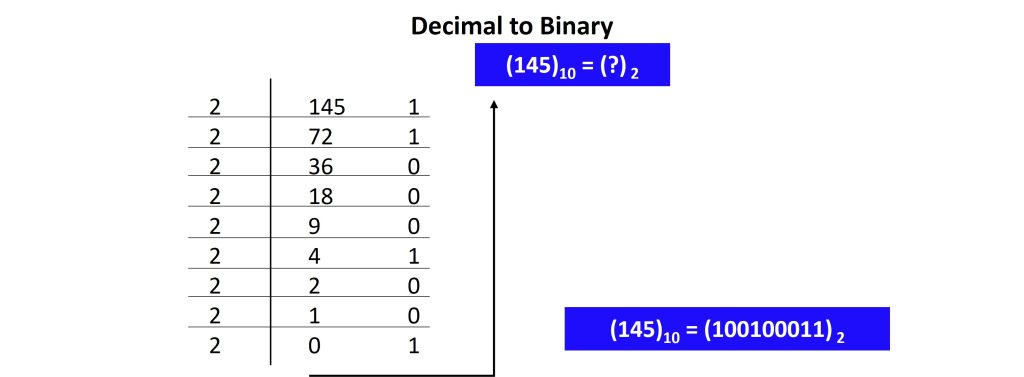
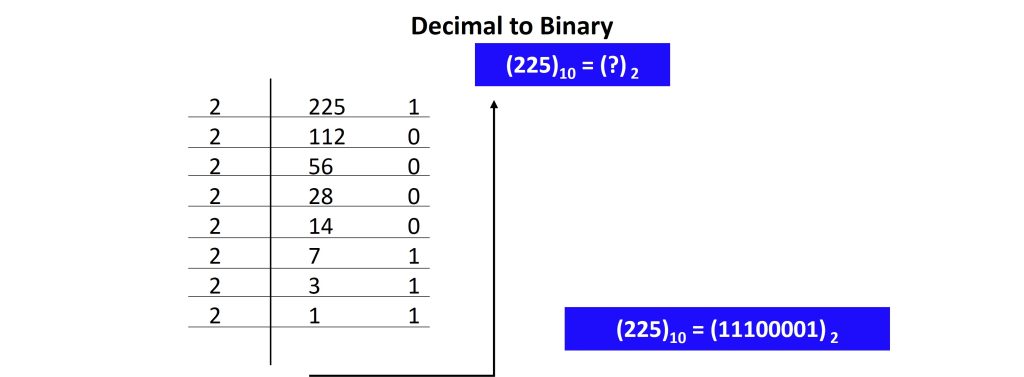
To convert a decimal number system to binary, here are some steps.
- Divide the decimal number by 2.
- Record the remainder (0 or 1).
- Divide the quotient again by 2 and repeat until the quotient becomes 0.
- Read the remainders backward (from last division to first) to get the binary number.
Decimal to Octal Conversion
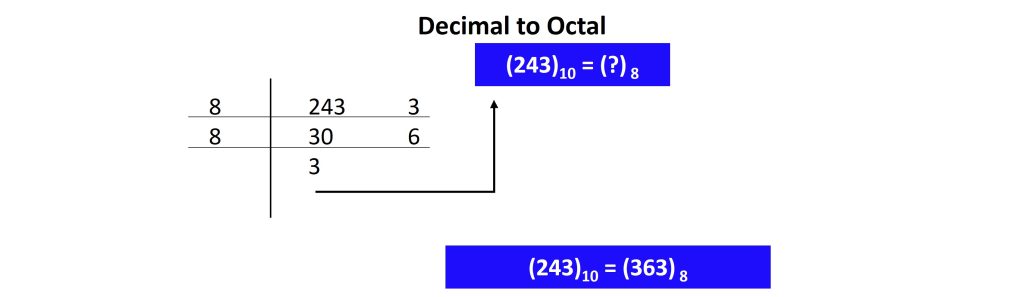
To convert a decimal number system to octal, here are some steps.
- Divide the decimal number by 8.
- Record the remainder (from 0 to 7).
- Divide the quotient again by 8 and repeat until the quotient becomes 0.
- Read the remainders backward (from last division to first) to get the octal number.
Decimal to Hexadecimal Conversion
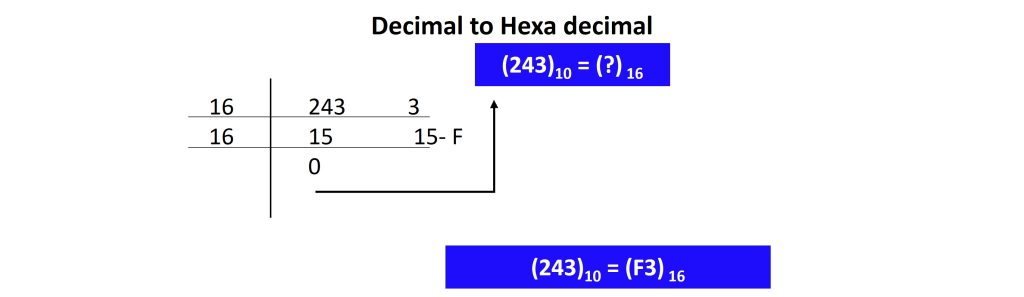
To convert a decimal number system to a hexadecimal number system, here are some steps.
- Divide the decimal number by 16.
- Record the remainder (from 0 to 15, where 0-9 is denoted by a number and from 10 to 15 represented by A-F, respectively).
- Divide the quotient again by 16 and repeat until the quotient becomes 0.
- Read the remainders backward (from last division to first) to get the octal number.