छोटो सारांश
- ChatGPT, Gemini र Microsoft Copilot नेपालमा फ्री छन्, र साधारण Android फोनमै चल्छन्। ल्यापटप चाहिँदैन।
- फ्री भर्सनले NEB को धेरैजसो काम गर्छ: च्याप्टर सजिलो भाषामा बुझ्न, Python को error सच्याउन, निबन्धको रूपरेखा बनाउन, नेपालीबाट अंग्रेजी अनुवाद गर्न।
- ChatGPT Plus महिनाको २० डलर पर्छ र त्यो डलरमै तिर्नुपर्छ। साधारण नेपाली डेबिट कार्ड प्रायः चल्दैन। डलर कार्ड चाहिन्छ।
- नेपालसँग जोडिएका कुरामा (मिति, पाठ्यक्रम, सरकारी नीति, स्थानीय इतिहास) AI ले आत्मविश्वासका साथ गलत जवाफ दिन्छ। किताबसँग मिलाएर मात्र पत्याउनुहोस्।
- जवाफ जस्ताको तस्तै कपी नगर्नुहोस्। पढ्नुहोस्, च्याट बन्द गर्नुहोस्, अनि आफ्नै शब्दमा लेख्नुहोस्। सिकाइ त्यहीँ हुन्छ।
Last verified: September 2026. Prices, free limits and app availability change often, so the pricing and access links in this post go straight to the official pages.
My cousin was failing Class 11 Physics before he started asking ChatGPT to re-explain his textbook chapters in plain language. He passed. AI did not do it for him. But having something that answers questions at 11pm, when his teacher is unreachable and tuition is over for the night, made a real difference.
If you are a student in Nepal and have not tried any of these tools yet, start here. This post covers what is actually free, what you can pay for from Nepal and how, which tool suits which NEB subject, and what these tools still get wrong. Everything below works on a basic Android phone with 2GB RAM and an NTC or Ncell data pack.
Which AI tool for which NEB subject
Students usually pick one app and use it for everything. That works, but you get better answers faster if you match the tool to the subject. Here is what I use, and why.
| Subject or task | Best free tool | Why this one | Watch out for |
|---|---|---|---|
| Computer Science theory (Class 9, 10, NEB 11 and 12) | ChatGPT | Explains definitions and gives NEB-style long answers without padding | Unit names and marks distribution may not match the current NEB syllabus |
| Python and C programming | ChatGPT or Claude | Reads your error message and tells you which line broke and why | It will happily rewrite your whole program if you let it. Ask for the explanation first |
| Physics and Maths numericals | Gemini | Shows the working step by step and handles photos of a question | Check the arithmetic yourself. Setup is usually right, final numbers sometimes are not |
| English essay, letter, application | Claude | Gives an outline and honest feedback on a draft you wrote | Submitting its draft unedited is plagiarism, and it reads nothing like you |
| Nepali to English translation | Gemini | Handles Devanagari input well and keeps the meaning of idioms | Formal Nepali letters come out too casual. Fix the register yourself |
| Account and Economics | ChatGPT | Good at journal entries, ledgers and explaining the logic behind a format | Nepali accounting formats differ from the Indian ones it defaults to |
| MCQ practice and revision | Any of them | Generates unlimited practice questions with one-line explanations | Some questions will be off-syllabus. Cross-check with a real question bank |
| Loksewa and current affairs | Gemini or Copilot | Both search the live web, so recent events are covered | Nepal-specific dates and vacancy details are often wrong. Verify on the official site |
If you are working through Computer Science specifically, pair the tool with real notes rather than using it alone. Our Class 10 Computer Science notes and the NEB Class 11 Computer Science Unit 1 notes follow the actual syllabus, which is exactly the thing AI keeps guessing at.
The four tools worth your time in 2026
There are dozens of AI apps. Most are not worth a student’s data. These four are.
ChatGPT (OpenAI)
The one everyone has heard of. The free tier handles most student work without trouble: explaining concepts, fixing grammar, debugging code, translating. You do not need the paid plan for NEB study. Free does have a daily message cap, and you will hit it if you chat for an hour straight, but it resets.
Runs on Android, iPhone and any browser. Best for explaining chapters, essay drafts and coding help.
Google Gemini
Gemini searches the live web, which the free ChatGPT tier is weaker at. That matters for project work and current affairs. Most Nepali students already have a Google account, so there is nothing to set up. Google lists the Gemini web app as available in over 230 countries and territories, and Nepal is one of them, so you do not need a VPN. You can check the current list on Google’s own availability page.
Runs on Android (often preinstalled), iPhone and browser. Best for research, summarising, fact-checking and Nepali translation.
Microsoft Copilot
Copilot runs in a browser at copilot.microsoft.com and works without an account for basic questions. It searches the web, makes images for free, and loads on an older Android phone where a heavy app would struggle. Useful if your phone storage is full.
Runs on any browser. Best for quick research, free image generation and getting started with zero setup.
Claude (Anthropic)
Claude gives longer, more careful answers and follows specific instructions well. Things like “explain this like I am 14”, “give me five practice questions”, or “tell me what I got wrong in this paragraph” work better here than anywhere else. The free tier has a daily limit that is fine for a study session.
Runs on browser, Android and iPhone. Best for deep explanations and feedback on your own writing.
Can you pay for ChatGPT Plus with a Nepali card?
This is the question I get most, so here is the honest answer.
OpenAI charges for ChatGPT Plus in US dollars and processes payment through Stripe. A normal NPR debit card from a Nepali bank usually fails at checkout, because most cards are issued without international transaction permission. The card is not broken. It simply is not enabled for dollar payments.
What works:
- A virtual dollar card from a Nepali bank’s mobile banking app. Several banks now issue these, and you load a small dollar balance before paying. Ask your bank whether the card supports recurring international charges, not just one-time ones. Recurring is what a subscription needs.
- An international credit card, if you already hold one.
- Paying through the Play Store or App Store if you have a working card saved there.
What I would avoid: the local resellers offering ChatGPT Plus for a fixed rupee price through eSewa or Khalti. Some are genuine, but many sell shared logins. A shared account means someone else can read your chats, the password can change without warning, and OpenAI can close the account for sharing. Save your money.
The short version: you almost certainly do not need Plus. The free tier covers NEB study. Spend the Rs 2,700 or so a month on a data pack or a question bank instead. Current prices and plan names are on the official OpenAI pricing page, which is the only place worth trusting for this.
How to set up ChatGPT on an Android phone in Nepal
Five minutes, no card, no VPN.
- Open the Play Store and install ChatGPT by OpenAI. The download is around 80MB, so do it on wifi if you can.
- Open the app and tap “Continue with Google”. Use the Gmail you already have. This is faster than creating a password and it avoids email verification problems.
- Skip every upgrade prompt. The free plan is selected by default and you do not need to enter any card.
- In Settings, turn on Voice if you want to ask questions out loud. Handy when your typing is slow in English.
- Ask your first real question. Not a test question. Something from today’s class that you did not follow.
How to ask questions that get useful answers
The biggest problem students have with AI is not the tool. It is the question.
“Help me with my assignment” gets a useless answer. Specific questions get specific answers. Three things make almost any prompt better: say your grade and board, say how simple you want it, and ask for an example.
For a chapter you did not understand
For essays and written assignments
Ask for an outline before the draft. Then write the draft yourself using that outline. Add your own school, your own examples, your own opinion. A draft you actually wrote is yours. A draft you copied is not, and teachers can usually tell within two sentences.
For exam preparation
If you are preparing for Loksewa rather than school exams, do the same thing with a past paper in front of you. Our solved Computer Operator paper from 2082 works well for this: feed it one question you got wrong and ask for three similar ones.
For Nepali and English translation
Using AI for Python without killing your own skill
Python is in the NEB Class 11 and 12 Computer Science syllabus. Most students get stuck the same way: the code throws an error and they have no idea where to begin.
Here is a loop that builds skill instead of replacing it.
- Write the code yourself first, even if you are sure it is wrong.
- Run it. Copy the full error message, not just the last line.
- Paste your code and the error and ask: “Explain what is wrong and why it happened. Do not give me the corrected code yet.”
- Read the whole explanation before touching anything.
- Close the chat. Rewrite the working version from scratch, from memory.
Step 5 is the one everybody skips. It feels slow. It is also the only step where the learning happens. After about ten rounds of this you start catching the same errors before you even run the file.
If you are starting Python from zero, do not learn it from a chatbot alone. Work through a structured sequence first and use AI for the stuck moments. Our Python programming for Class 9 series is built for exactly that, and the rest of the free tools on the site cover the small jobs AI is bad at, like Preeti to Unicode conversion and BS to AD dates.
What AI gets wrong in NEB answers
This is the part most AI guides skip, and it is the part that costs marks.
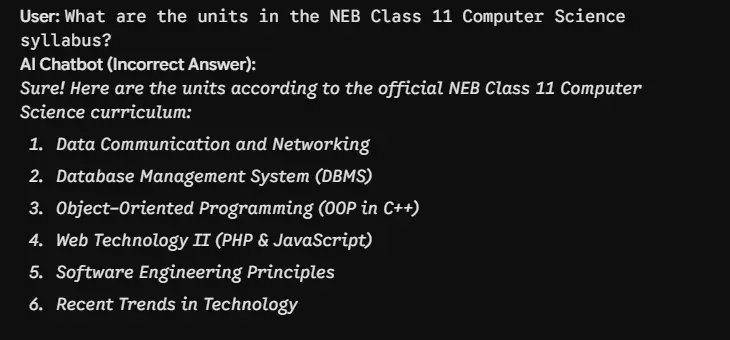
Four failure modes show up again and again in Nepali student work.
Syllabus drift is the most common. Ask about NEB unit names, marks distribution or chapter order and you will get an answer shaped like a syllabus that is not ours. The model has read far more Indian CBSE material than Nepali NEB material, so that is what it produces.
Nepal-specific facts are the second. Dates in Bikram Sambat, government policy, local history, exam schedules, current ministers. It guesses, and it guesses fluently, which is worse than guessing badly.
Answer length is the third. NEB marks are tied to length and structure. A five mark question wants a specific shape. AI writes essays where you needed four labelled points, or four lines where you needed a diagram plus explanation.
The fourth is quiet and does real damage: it invents citations, statistics and book references. If your project report needs a source, find the source yourself.
The fix is simple and boring. Treat every Nepal-specific claim as unverified until you have matched it against your textbook or a Nepali source. Use AI for the explaining, not for the facts.
What the research says about leaning on it too hard
There is one study worth knowing about before you make AI your main study method.
Researchers at MIT Media Lab ran an EEG study with 54 participants writing essays in three conditions: with an LLM, with a search engine, and with no tools at all. Across the sessions, the LLM group showed the weakest brain connectivity of the three, and the brain-only group the strongest. LLM users also struggled to quote from essays they had finished minutes earlier, and reported a weaker sense of ownership over their own work. The paper is Kosmyna et al., “Your Brain on ChatGPT” (2025), and you can read the project page at MIT Media Lab.
Read it properly before repeating it. It is a small study, only 18 people completed the fourth session, and it measured essay writing rather than studying in general. It does not prove AI makes you stupid, whatever your Facebook feed says. What it does suggest is that the easier a task feels, the less of it sticks. That matches what every teacher already tells you about copying notes versus writing them.
Tools and tricks for a 2 Mbps connection
Most students in Nepal are working with a shared connection, a data pack, or both. Everything below is chosen for low data and low RAM.
- Gemini in the browser at gemini.google.com uses less data and storage than the app. On a phone with 2GB RAM, skipping the install is often the difference between usable and not.
- Copilot in a browser tab needs no account and no download at all.
- Turn off voice mode and image generation. Both are far heavier than text.
- Type your full question offline, then send it when you connect. You pay for one exchange instead of five half-formed ones.
- Screenshot long answers instead of reloading the chat later. Reopening a conversation re-downloads it.
- For genuinely offline study, download your answers as text and keep them in a notes app. Also keep PDF notes on the phone so a dead connection does not stop your revision.
If you want something that runs fully offline, small models like Gemma or Llama do exist for Android through apps such as PocketPal. Be realistic though: they need roughly 4GB of free storage, they are slow on a budget phone, and the answers are noticeably weaker than Gemini’s. For most students it is not worth the space.
A daily routine that works
You do not need a system. This is enough.
After class, ask Gemini for five bullet summaries of what you studied today. Compare them with your own notes. Anything that does not match is what you re-read tonight, not tomorrow.
Before bed, ask for five practice questions on the same topic. Answer them without looking anything up. Wrong answers tell you more than right ones.
Before an exam, ask which topics are most commonly tested in your subject, then spend your last hours there. Verify the list against past papers, because this is exactly the kind of Nepal-specific claim the model tends to invent.
Free AI tools for students in Nepal, compared
| Tool | Free? | Works on mobile? | Handles Nepali? | Best for |
|---|---|---|---|---|
| ChatGPT | Yes, daily limit | Yes, app or browser | Decent | Concepts, code, essay outlines |
| Google Gemini | Yes, generous limit | Yes, best on Android | Good | Research, translation, quick answers |
| Microsoft Copilot | Yes, no account needed | Yes, browser only | Decent | Web research, images, zero setup |
| Claude | Yes, daily limit | Yes, app or browser | Decent | Long explanations, writing feedback |
The mistake that cancels out the benefit
Students read an answer, feel that click of understanding, and move on. That feeling is not understanding. It is recognition, and it disappears by exam day.
The test is whether you can explain the thing back with the screen off. After you get an answer, close the chat and write what you learned in your own words. If you cannot, go back and ask a follow-up. Keep going until you can explain it to a friend from memory.
That is where the learning happens. The AI just gets you there faster than waiting for the next class.
Where to start
Pick one tool. Open it now. Ask about something from today’s class that genuinely confused you.
Gemini is the easiest start on an Android phone: usually already installed, free, no separate account. Type the way you would text a friend for help. If the answer is unclear, tell it to simplify. Once you are comfortable with one, the others take five minutes to learn. They all work the same way.
Frequently asked questions
Is ChatGPT free in Nepal?
Yes. ChatGPT works in Nepal on the free plan with no card, no VPN and no payment. You sign in with a Google account and get a daily message limit that resets. The paid Plus plan is optional and is not needed for NEB study.
Can I pay for ChatGPT Plus with a Nepali debit card?
Usually not. OpenAI bills in US dollars and most NPR debit cards are issued without international transaction permission, so the payment is declined. The working options are a virtual dollar card from a Nepali bank’s mobile banking app, or an international credit card. Check that the card allows recurring charges, not just one-time ones.
Which AI is best for NEB Computer Science?
ChatGPT for theory and Python, Gemini for anything needing current information or Nepali translation. Neither knows the NEB syllabus reliably, so check unit names, chapter order and marks distribution against your own textbook.
Does Gemini understand Nepali?
Yes. You can type in Devanagari and it replies in Nepali. It is the strongest of the free tools for Nepali to English translation. Formal Nepali letters still come out too casual, so adjust the tone yourself.
Will my teacher know if I use AI to write my homework?
Often, yes. AI writing has a recognisable rhythm and it will not sound like your usual work. AI detector tools are also unreliable and flag honest students, which is a separate problem. The safe approach is to use AI for outlines, explanations and feedback, then write the submitted text yourself.
Which AI tool works best on a slow connection?
Gemini or Copilot in a browser tab. Both avoid an app install, use little data per message, and run on phones with 2GB RAM. Turn off voice and image generation to cut data use further.
Sources: OpenAI pricing and plans (openai.com), Gemini Apps availability (support.google.com), Kosmyna et al., “Your Brain on ChatGPT: Accumulation of Cognitive Debt when Using an AI Assistant for Essay Writing Task”, arXiv:2506.08872, MIT Media Lab, 2025.

Published June 2026. Last verified and updated: September 2026.