If you’ve been teaching or studying under the older Computer Science syllabus, the new specification grid will feel like a different subject. QBasic is gone. In its place: Python, a full unit on AI and contemporary technologies, and a stronger focus on databases and networking. Whether that’s good news or bad news probably depends on how attached you were to QBasic.
The Basics First
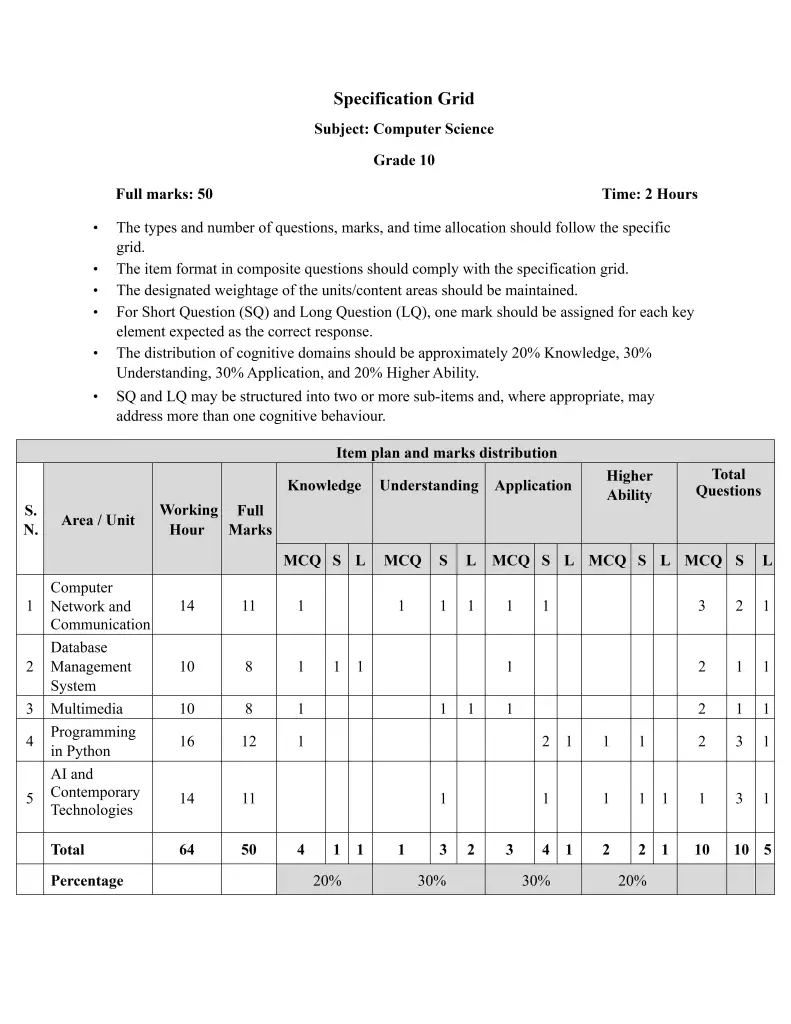
The paper carries 50 full marks and runs for 2 hours. That splits into 10 multiple-choice questions worth 1 mark each, 10 short questions worth 2 marks each, and 5 long questions worth 4 marks each, for 25 questions total.
| Question Type | Number | Marks Each | Total Marks |
|---|---|---|---|
| Multiple Choice (Group A) | 10 | 1 | 10 |
| Short Questions (Group B) | 10 | 2 | 20 |
| Long Questions (Group C) | 5 | 4 | 20 |
| Total | 25 | 50 |
Download Grid and Model Question
Unit-Wise Weightage
Five units carry the whole paper. Python and the Networking unit get the most weight, so that’s where your study hours should go first if time is tight.
| Unit | Working Hours | Marks |
|---|---|---|
| Computer Network and Communication | 14 | 11 |
| Database Management System | 10 | 8 |
| Multimedia | 10 | 8 |
| Programming in Python | 16 | 12 |
| AI and Contemporary Technologies | 14 | 11 |
| Total | 64 | 50 |
Cognitive Level Split
Questions are meant to be distributed roughly as 20% Knowledge, 30% Understanding, 30% Application, and 20% Higher Ability, with a variance of up to 2 marks allowed either way. In practical terms: a quarter of the paper rewards straight recall, but over half of it wants you to actually apply what you know, not just recite it. Pure memorization will only get you so far this time around.
What This Means for Your Preparation
Python is worth the most marks of any single unit, and it’s also the one most students are newest to, so it deserves a disproportionate share of your revision time. Don’t skip writing actual code by hand; a chunk of the “Application” and “Higher Ability” marks in this unit come from reading a short program and predicting or fixing its output.
Networking and AI/Contemporary Technologies are close behind in weight. Both tend to reward students who can explain why something works, not just define it, so practice answering “how” and “why” questions out loud, not just memorizing definitions.
Multimedia and Database Management System carry less weight individually, but they’re also the fastest to revise well since the content is more definitional. Good ROI for the last few days before the exam.

Published September 2026. Last verified: September 2026.